
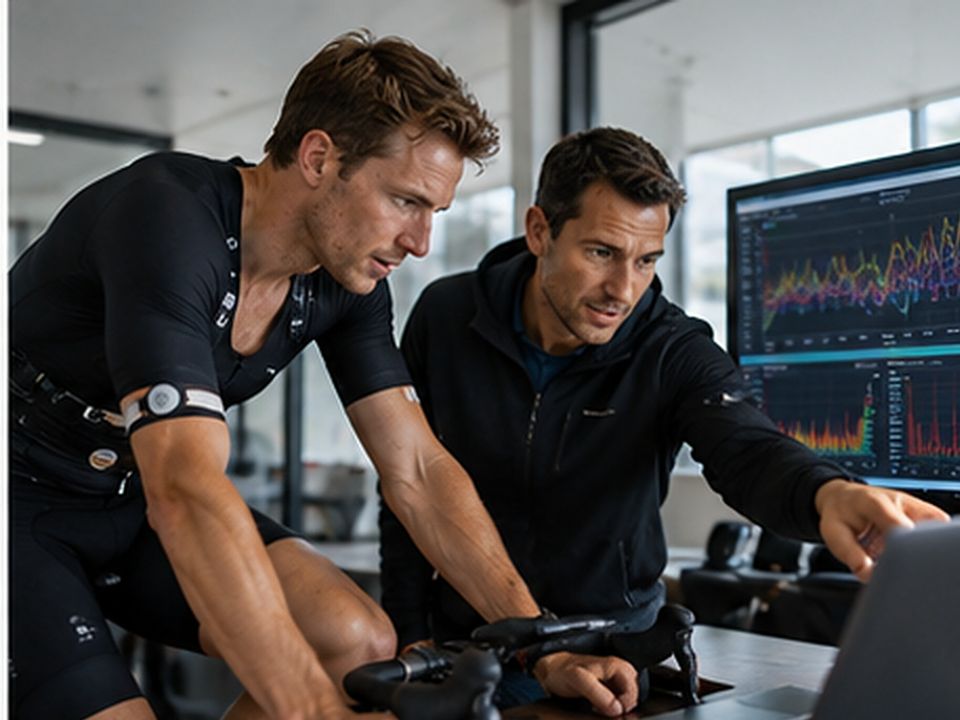
The future of endurance coaching is becoming less about finding the perfect programme and more about making better decisions for the individual athlete.
Traditional training advice often starts with averages: typical training loads, typical responses, typical recovery times and typical race preparation. Precision coaching takes a different approach. It asks what this athlete is responding to, what their history shows, what their current data says and how their training should change as that picture develops.
A recent review of genetics, omics and digital health in sports medicine describes this shift towards more individualised athlete management. The review brings together developments in genetics, wearable technology, digital health and multi-omics, but its practical message for everyday coaching is simpler: athletes differ, and useful coaching should account for those differences.
The athlete is more than the training plan
An athlete’s response to training is influenced by more than the programme written on paper. Training history, physiology, biomechanics, sleep, nutrition, stress and previous injury can all affect how an athlete responds.
That means two athletes can complete the same session and experience very different outcomes. One may absorb the workload well; another may need more recovery or a different progression.
For a coach, the implication is important. The programme is not the finished product. It is a starting point that needs to evolve as the athlete responds.
More data does not automatically mean better coaching
Wearables now provide a continuous stream of information: heart rate, power or pace, training load, HRV, sleep, recovery measures and environmental conditions.
That creates an opportunity to understand the athlete in much greater detail. But collecting data is not the same as coaching.
The useful step is interpretation. A change in HRV, for example, means something different when considered alongside recent training load, sleep, subjective fatigue, illness, stress and performance. The value comes from looking for patterns over time rather than reacting to every individual data point.
Genetics are interesting — but they are not destiny
Genetic testing is one of the areas attracting attention in precision sports medicine. The review highlights its potential, but also the limitations of the current evidence.
Endurance performance is not controlled by a single gene, and a genetic profile should not be treated as a simple blueprint for athletic potential. Small studies, population differences and gene-environment interactions make simplistic predictions inappropriate.
For most endurance athletes, longitudinal information collected during training may therefore be more immediately useful: how the athlete responds to different workloads, how quickly they recover, how performance changes and which patterns repeatedly appear.
The emerging ‘digital athlete’
The concept of the digital athlete brings these information streams together. Training load, performance, recovery, sleep, heart rate, HRV, subjective feedback, injury history and race history can collectively create a much richer picture of the athlete.
Artificial intelligence may help identify patterns within large datasets, but the review does not replace the coach with technology. The coach remains responsible for interpreting the information and deciding what should change.
That distinction matters. Technology can make a coach better informed; it does not remove the need for coaching judgement.
What this means for the everyday endurance athlete
Precision coaching is not reserved for elite athletes with genetic testing and laboratory-grade monitoring.
The same principle can be applied to a serious recreational runner, cyclist or triathlete with relatively simple information.
Understand the athlete’s goals and history. Measure what actually matters. Monitor how they respond. Combine objective data with how the athlete feels. Look for patterns. Then adjust the training.
The goal is not to collect every possible metric. It is to improve the quality of the decisions being made.
MCC’s Take
At MCC, the useful idea is not that every athlete needs more technology. It is that the training process should evolve around the athlete rather than forcing the athlete to fit a standard programme.
The athlete provides the context. Data helps reveal the pattern. The coach decides what to do with it.
There is no perfect programme that works indefinitely. There is, however, a better process for continually making better decisions as the athlete changes.
Train the athlete you have — not the athlete represented by an average.
Source:
Juginović A, et al. “Next-Generation Approaches in Sports Medicine: The Role of Genetics, Omics, and Digital Health in Optimizing Athlete Performance and Longevity — A Narrative Review.” Life. 2025;15(7):1023. https://doi.org/10.3390/life15071023 — primary review for the article’s precision-sports-medicine, digital-health and individualisation discussion; caveats around genetics are retained.