
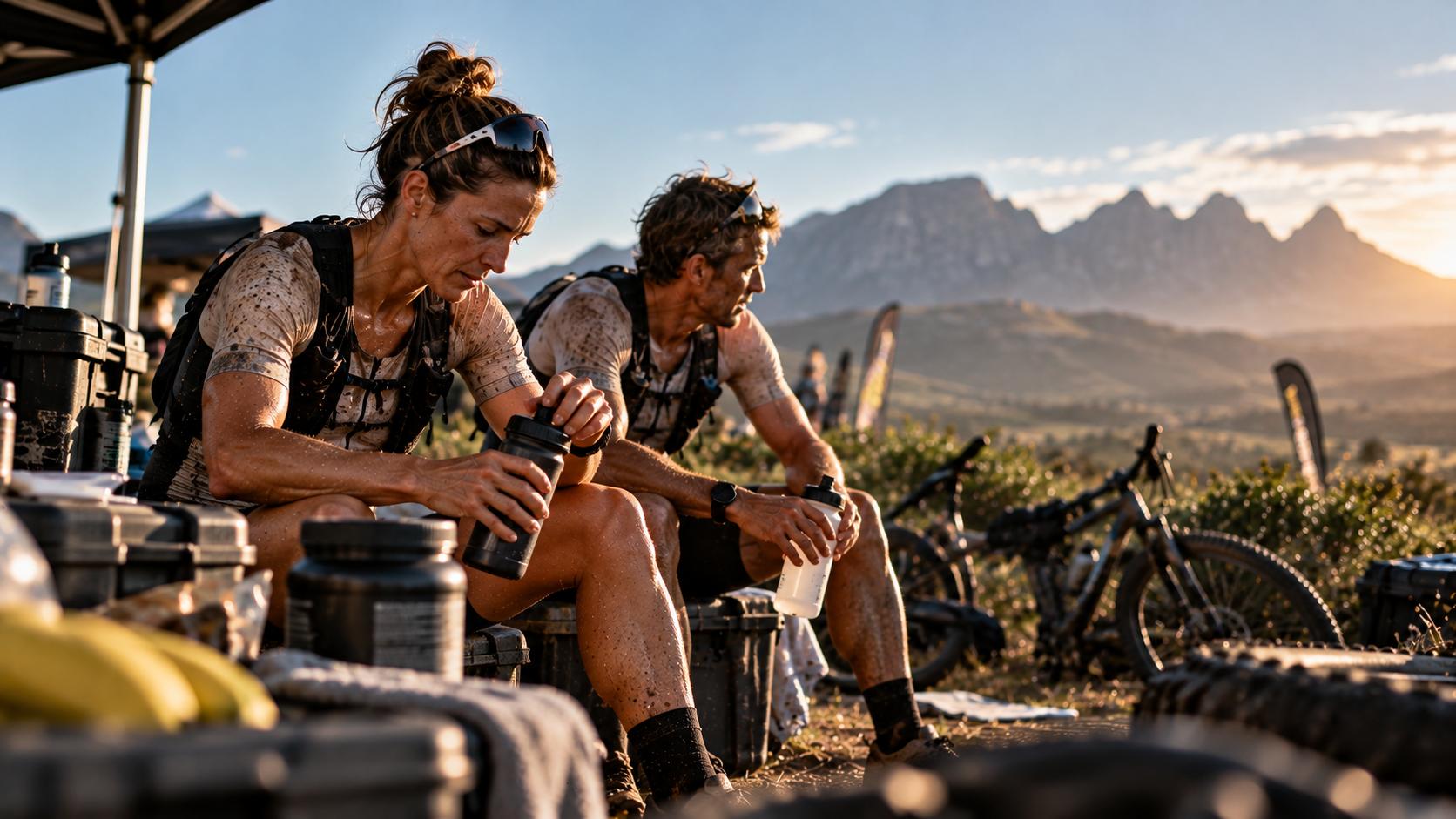
Endurance athletes are continually offered new ways to recover faster. Ketone products are one of the more sophisticated pitches: they aim to raise circulating ketones, a fuel source the body can use, and some research has explored whether this may help athletes manage the stress of hard training or competition.
But a useful question for coaches is not whether a supplement changes a biomarker. It is whether it improves something an athlete actually cares about: recovery, sleep, cognitive function, readiness to train or performance.
A study published online on 9 October 2026 in the European Journal of Sport Science tested that question in a real-world setting: the 2025 Absa Cape Epic.
What did the researchers test?
The double-blind, placebo-controlled study involved 18 trained mountain bikers competing in an eight-day stage race. Participants received either R-1,3-butanediol (BDO), a ketone precursor, or a placebo twice daily—after each stage and before sleep.
The researchers assessed several outcomes, including physiological strain, nutritional intake, hydration, cognitive performance, sleep and athletes’ subjective recovery. The BDO supplement induced mild ketosis, showing that it had a measurable metabolic effect.
However, that change did not translate into a significant improvement in the measured recovery outcomes. Compared with placebo, BDO did not meaningfully improve cardiovascular responses, subjective recovery, cognitive performance, sleep or nutritional intake.
The distinction between a mechanism and a benefit
This is the important coaching lesson. A supplement can change a physiological marker without producing a meaningful improvement in how an athlete feels, adapts or performs. Inducing ketosis is not, on its own, proof of better recovery.
The result also needs to be interpreted precisely. The researchers tested one ketone precursor, at a particular dose and timing, in a small group during a demanding stage race. Only three women completed the study, so the findings cannot confidently be generalised across sexes or all endurance athletes.
Nor does this study establish that every ketone formulation is ineffective. Ketone precursors and ketone monoesters differ in their effects and cannot be treated as interchangeable. The sensible conclusion is narrower: under the conditions tested, this BDO protocol did not deliver measurable recovery benefits.
What should endurance athletes prioritise?
During a multi-day event, recovery is shaped by the combined demands of training or racing, energy availability, carbohydrate intake, hydration, sleep and the athlete’s overall load. A supplement should be considered in that context—not as a substitute for the basics.
For athletes preparing for a stage race, a practical approach is to:
- Eat enough to meet the workload. Large energy deficits can make it harder to recover between stages.
- Plan carbohydrate intake around the demands of training and racing. The amount and timing should reflect duration, intensity, tolerance and the next session.
- Replace fluid and electrolytes appropriately. Sweat losses vary widely, so a one-size-fits-all prescription is rarely ideal.
- Protect sleep and recovery time. Travel, race schedules, nerves and late finishes can all compromise recovery.
- Test strategies in training. Race week is a poor time to discover that a supplement or fuelling plan does not suit you.
The MCC takeaway
The Cape Epic study is a useful reminder to judge recovery products by outcomes, not marketing language or a single biomarker. It does not close the door on future ketone research, but it provides no reason to treat this particular BDO protocol as a proven recovery tool for stage racing.
For most endurance athletes, the first investment should be a well-executed plan for fuelling, hydration, sleep and training load. Supplements belong in the conversation only when there is a clear rationale, credible evidence and a fit with the individual athlete.
Source: Engelbrecht and colleagues, Post-Exercise R-1,3-Butanediol did not Improve Markers of Fatigue or Recovery During a Multi-Stage Mountain Bike Race, European Journal of Sport Science, first published 9 October 2026. https://doi.org/10.1002/ejsc.70260
Source:
Primary study: https://doi.org/10.1002/ejsc.70260