
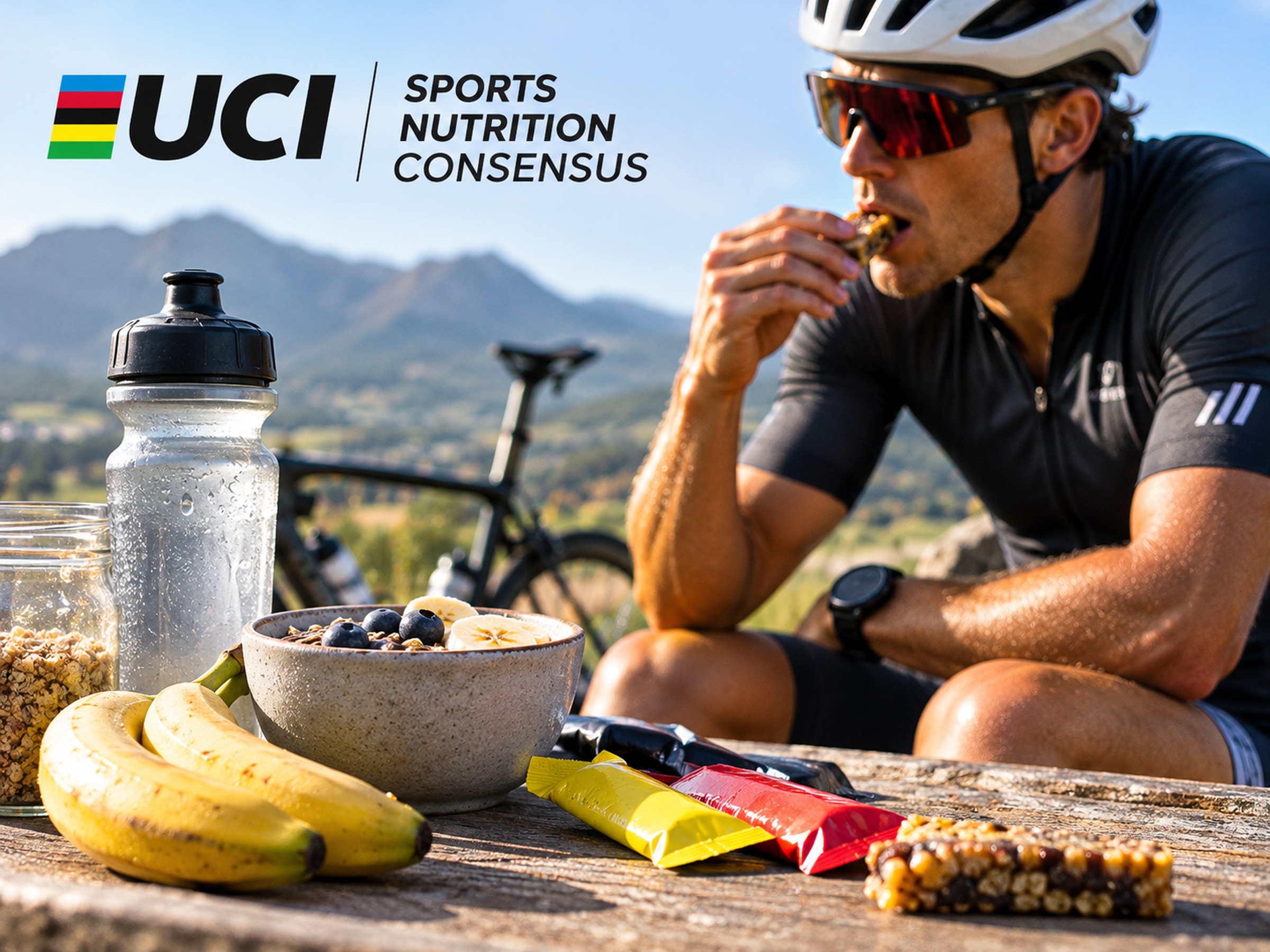
Sports nutrition advice can change quickly—and it is often reduced to a single number, product or protocol. A new position statement from the UCI Sports Nutrition Project offers a timely opportunity to step back and look at the bigger picture.
Published in November 2026, the statement brings together 14 topic-specific reviews and input from 54 researchers. Its scope extends across preparation, race fuelling, recovery and adaptation, energy availability, physique management, illness and injury, supplements and sports foods, technology, and considerations related to age and sex.
For endurance athletes, the most useful takeaway is not that everyone should adopt a new universal nutrition plan. It is that nutrition decisions need to be considered as part of the athlete’s wider performance and health context.
Nutrition is more than race-day fuelling
Carbohydrate intake during training and competition understandably receives a great deal of attention. But it is only one part of the nutrition picture.
An athlete’s strategy also needs to account for:
- Everyday energy availability: Is the athlete consistently eating enough to support training, recovery and general health?
- Training and competition demands: Does the nutrition plan reflect the duration, intensity and demands of the event?
- Recovery and adaptation: Is the athlete able to replenish energy and support recovery between sessions or race stages?
- Health and resilience: Are nutrition choices supporting the athlete’s health over the longer term, rather than focusing only on immediate performance?
- Practical execution: Can the athlete tolerate, access and consistently follow the plan?
These questions are connected. A race-day strategy cannot compensate for a pattern of inadequate fuelling across the training week.
There is no single plan for every endurance athlete
A nutrition recommendation developed in one sporting context should not automatically be treated as a prescription for every runner, mountain biker, gravel rider or triathlete.
Athletes differ in training history, body size, event demands, experience, preferences, gastrointestinal tolerance, health considerations and access to food and sports products. Their needs can also change between training phases, competition and recovery.
That does not mean evidence-based guidelines are unhelpful. It means guidelines should inform decisions rather than replace them.
The coaching question is not simply, “What does the consensus recommend?” It is also, “How does this evidence apply to this athlete, this event and this phase of training?”
Fuelling should be practised—not improvised
For long endurance sessions and races, athletes need a strategy they can execute when fatigue, intensity and conditions make eating and drinking more difficult.
That strategy should be rehearsed during appropriate training sessions. Athletes can use those sessions to assess:
- Which foods or products they tolerate comfortably
- How timing and intake work at their intended race intensity
- Whether their plan remains practical over the expected duration
- How fluid and fuelling choices interact in different conditions
- What adjustments may be needed for heat, terrain or aid-station access
The goal is not to chase the highest possible intake or copy another athlete’s race plan. It is to develop a reliable approach that matches the event and the individual.
Supplements are one part of the conversation
Sports foods and supplements have a place in some athletes’ strategies, but they should not distract from the fundamentals.
Before adding another product, athletes and coaches should consider the purpose it is meant to serve, the quality of the evidence, whether it is appropriate for the individual, and whether it addresses a genuine need.
A product should not become a substitute for adequate overall nutrition, sensible training progression or recovery.
The new position statement’s broad scope is a useful reminder to consider supplements alongside energy availability, health, training demands and the athlete’s wider nutrition strategy—not in isolation.
What South African endurance athletes should consider
South African athletes may face very different environments and practical constraints: hot conditions, long exposed rides or runs, technical trails, multi-stage events and varying access to nutrition products or support.
A plan that works in one event may need adjustment for another. Heat, duration, intensity, terrain and the availability of food and fluids all matter.
Athletes preparing for events such as long-distance road races, MTB stage races, gravel events or triathlons should therefore work through the demands of their specific event rather than relying on a generic nutrition template.
Where an athlete has medical, nutritional or other health concerns, individual advice from an appropriately qualified professional is important.
The MCC coaching perspective
The value of a consensus statement is that it helps organise the evidence and identify the questions coaches and athletes should be asking.
It does not remove the need for individual judgement.
At MCC, the practical approach is to start with the athlete and the event: understand the training load, performance objective, health context and real-world demands. Then use the available evidence to develop a nutrition strategy that can be practised, evaluated and refined.
Athlete takeaway: don’t look for one nutrition rule that solves every problem. Build a strategy around your training and event demands, practise it, pay attention to how you respond, and seek qualified guidance when your needs extend beyond general sports-nutrition advice.
—
Research source
UCI Sports Nutrition Project. UCI Sports Nutrition Project Position Statement on Nutrition for Cycling and Endurance Performance (2026).
- PubMed: https://pubmed.ncbi.nlm.nih.gov/42744290/
- Maastricht University research record: https://cris.maastrichtuniversity.nl/en/publications/uci-sports-nutrition-project-position-statement-on-nutrition-for-/
Editorial fact-check before publication: Confirm the final published title, journal citation, publication date and full-text recommendations against the original paper. This article is an MCC interpretation of the statement’s broad scope; it intentionally avoids presenting cycling-specific guidance as universal advice for all endurance sports.
Source:
UCI Sports Nutrition Project Position Statement (2026), PubMed: https://pubmed.ncbi.nlm.nih.gov/42744290/ ; Maastricht University: https://cris.maastrichtuniversity.nl/en/publications/uci-sports-nutrition-project-position-statement-on-nutrition-for-/